

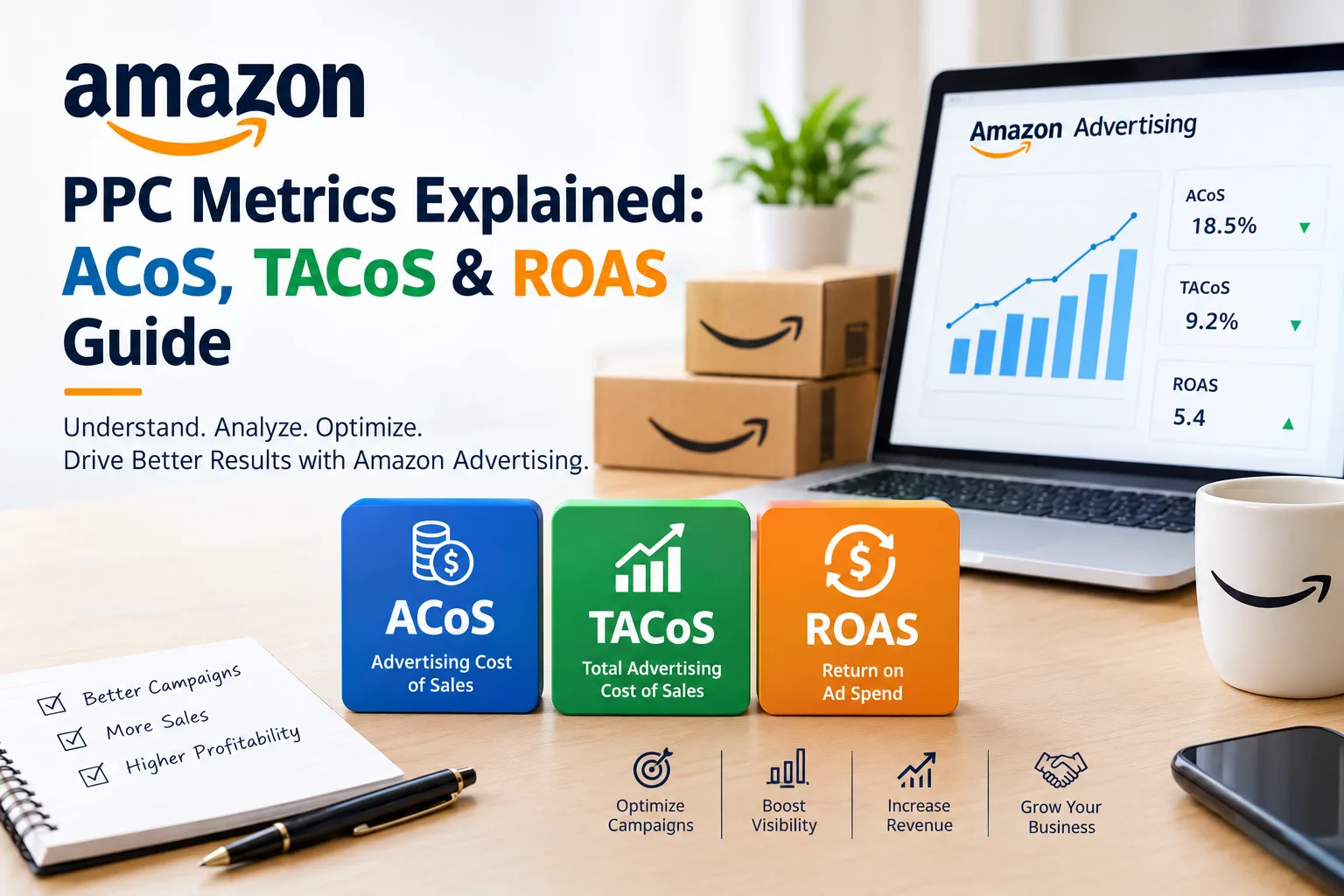
Amazon PPC Metrics Explained: ACoS, TACoS & ROAS Guide
Running Amazon advertising campaigns is not just about getting clicks or increasing product sales. The real goal is to generate profitable revenue, control advertising costs, and build long-term business growth. To achieve these goals, sellers need to understand the key performance indicators that show whether their advertising campaigns are working effectively. This is where ACoS TACoS ROAS Amazon Advertising metrics become essential.
Amazon provides sellers with advertising reports and performance data, but understanding these numbers is just as important as running the campaigns. Advertising Cost of Sales (ACoS) measures advertising spend against sales generated through ads. Total Advertising Cost of Sales (TACoS) compares advertising spend with total sales, including organic sales. Return on Ad Spend (ROAS) measures the revenue generated for every rupee spent on advertising.
Each metric provides a different view of campaign performance. Looking at only one number can lead to poor decisions, such as cutting a profitable campaign or spending too much on keywords that do not convert.
In this guide, we will explain ACoS, TACoS, and ROAS in Amazon Advertising, including their formulas, practical examples, differences, and optimization strategies. You will also learn how Avisha Digital Services can help sellers improve campaign performance through Amazon advertising management, product listing optimization, and marketplace growth strategies.
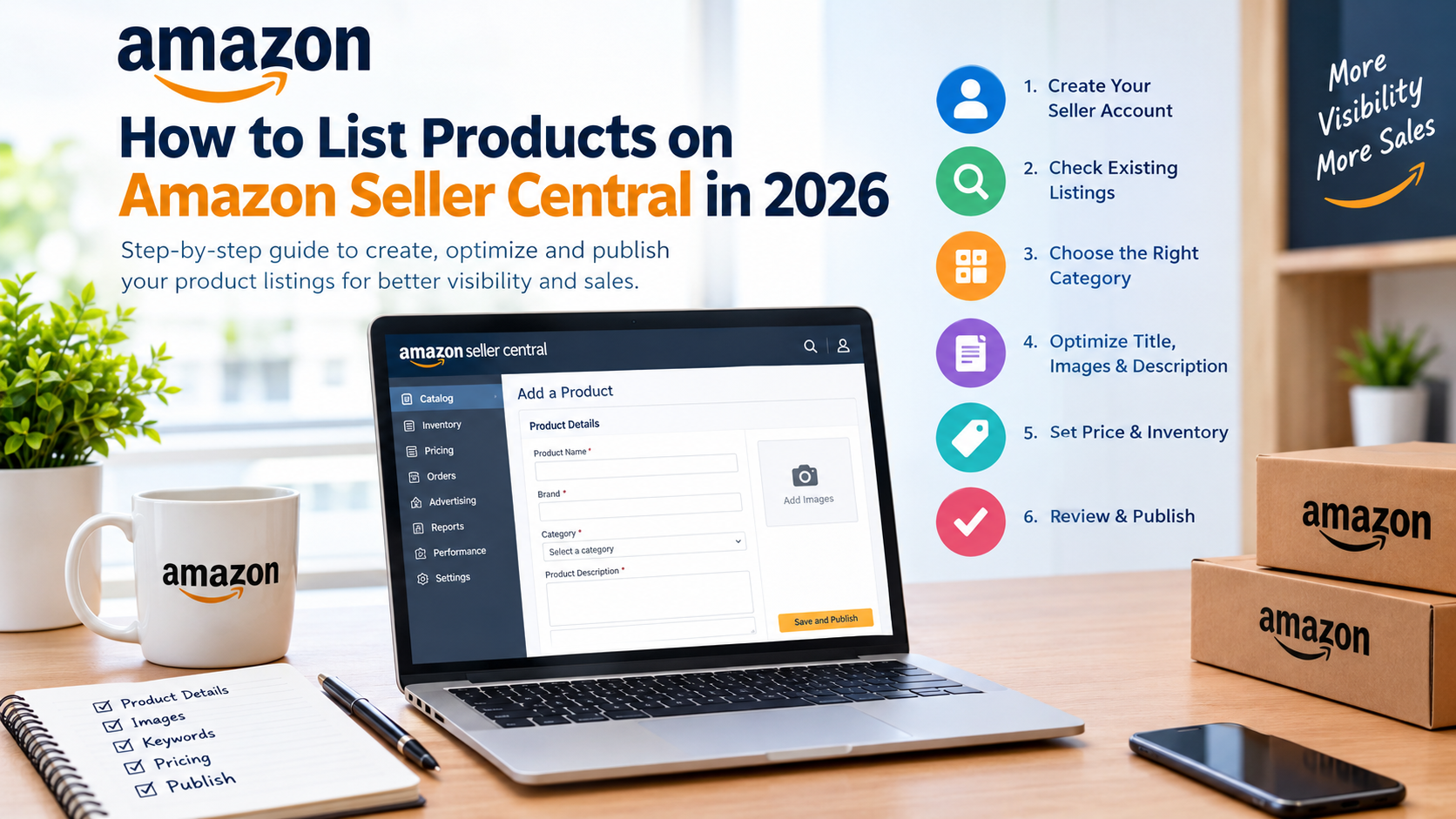
Read more – How to list products on Amazon
What Are ACoS, TACoS, and ROAS in Amazon Advertising?
ACoS, TACoS, and ROAS are three important metrics used to evaluate Amazon PPC campaign performance. They help sellers understand advertising efficiency, overall sales growth, and the revenue generated from their advertising budgets.
Although these metrics are related, each answers a different question.
- ACoS: How much are you spending on advertising to generate attributed sales?
- TACoS: How much are you spending on advertising compared with your total sales?
- ROAS: How much attributed revenue are you generating for every rupee spent on advertising?
For example, a campaign may have a low ACoS but generate very few sales. Another campaign may have a higher ACoS but help increase total sales and improve product visibility. Understanding all three metrics allows sellers to make better decisions.
1. What Is ACoS in Amazon Advertising?
Advertising Cost of Sales, or ACoS, is the percentage of advertising-attributed sales spent on Amazon PPC campaigns.
In simple terms, ACoS tells you how much you spend on ads to generate a specific amount of sales revenue attributed to those ads.
ACoS Formula
ACoS = (Advertising Spend ÷ Advertising-Attributed Sales) × 100
ACoS Example
Suppose your Amazon PPC campaign has the following performance:
- Advertising spend: ₹5,000
- Advertising-attributed sales: ₹25,000
Your ACoS would be:
ACoS = (₹5,000 ÷ ₹25,000) × 100
ACoS = 20%
This means you spent ₹20 on advertising for every ₹100 in sales attributed to your ads.
Is a Low ACoS Always Better?
A lower ACoS can indicate better advertising efficiency, but it does not automatically mean your business is more profitable.
Your product’s selling price, cost of goods, Amazon referral fees, fulfilment charges, discounts, and other expenses all affect profitability.
For example, an ACoS of 15% might be excellent for a product with healthy margins. However, the same ACoS could still be unprofitable for a product with very low margins.
How to Calculate Your Target ACoS
Your target ACoS should be based on your product’s profit margin before advertising.
Break-even ACoS = Profit Margin Before Advertising × 100%
If your product has a 30% contribution margin before advertising, your break-even ACoS is approximately 30%. At that level, advertising consumes the entire contribution available before ad costs, leaving no contribution after advertising.
For a profit target, you generally need an ACoS below your break-even level.
How to Improve ACoS
To improve ACoS without unnecessarily reducing sales, consider these actions:
- Add negative keywords for irrelevant search terms.
- Reduce bids on keywords that spend money without generating enough sales.
- Increase bids selectively on keywords that convert profitably.
- Improve product titles, images, bullet points, and product descriptions.
- Review placement performance and adjust placement multipliers when justified.
- Monitor campaign performance over a suitable period before making major changes.
Improving conversion rates is often as important as lowering bids because a better-converting listing can generate more sales from the same advertising traffic.
2. What Is TACoS in Amazon Advertising?
Total Advertising Cost of Sales, or TACoS, measures advertising spend against total sales generated by your Amazon business.
Unlike ACoS, TACoS includes both advertising-attributed sales and sales that come from other sources, such as organic search visibility.
This makes TACoS especially useful for understanding how advertising relates to overall business growth.
TACoS Formula
TACoS = (Advertising Spend ÷ Total Sales) × 100
Total sales generally include both ad-attributed and non-ad-attributed sales for the same reporting period. Use consistent sales definitions and dates when comparing performance.
TACoS Example
Imagine your Amazon account generates the following results in one month:
- Advertising spend: ₹10,000
- Advertising-attributed sales: ₹40,000
- Organic and other non-ad-attributed sales: ₹60,000
- Total sales: ₹1,00,000
Your TACoS would be:
TACoS = (₹10,000 ÷ ₹1,00,000) × 100
TACoS = 10%
This means your advertising costs represent 10% of your total Amazon sales.
Why Is TACoS Important?
TACoS helps sellers understand whether their advertising investment supports overall sales growth.
For example, suppose advertising spend stays at ₹10,000 while total sales increase from ₹80,000 to ₹1,00,000. TACoS decreases from 12.5% to 10%.
This can be a positive sign because your business is generating more total revenue without increasing advertising spend.
However, a lower TACoS is not always evidence of improvement. It can also happen when advertising spend falls and total sales remain stable temporarily, or when sales decline at a different rate from advertising spend. Always examine the underlying numbers.
How to Reduce TACoS and Grow Total Sales
To improve TACoS sustainably, focus on more than advertising efficiency.
- Improve organic rankings: Target relevant search terms and build strong product detail pages.
- Optimize product listings: Use clear images, accurate product information, and relevant keywords.
- Maintain inventory: Avoid stockouts that can interrupt sales and weaken momentum.
- Improve conversion rates: Review price competitiveness, customer reviews, and product content.
- Expand profitable campaigns: Invest in campaigns that contribute to sustainable sales growth.
- Monitor total revenue: Compare advertising spend with total sales every week or month.
TACoS is particularly useful when assessing the broader impact of advertising on a product’s performance over time.
3. What Is ROAS in Amazon Advertising?
Return on Ad Spend, or ROAS, measures the amount of advertising-attributed revenue generated for every unit of currency spent on advertising.
While ACoS is expressed as a percentage, ROAS is typically expressed as a ratio.
ROAS Formula
ROAS = Advertising-Attributed Sales ÷ Advertising Spend
ROAS Example
Suppose you spend ₹8,000 on an Amazon Sponsored Products campaign and generate ₹40,000 in attributed sales.
ROAS = ₹40,000 ÷ ₹8,000
ROAS = 5
Your campaign generates ₹5 in attributed revenue for every ₹1 spent on advertising.
A ROAS of 5 is also commonly written as 5:1.
What Is a Good ROAS on Amazon?
There is no single ROAS target that works for every Amazon seller. The right target depends on your profit margins, product category, average selling price, and business objectives.
For example:
- A high-margin product may remain profitable with a relatively low ROAS.
- A low-margin product may require a much higher ROAS to cover its costs.
- A newly launched product may temporarily prioritize visibility and sales data over immediate profitability.
A campaign’s ROAS should always be assessed alongside contribution margin and other operating costs.
How to Improve ROAS
You can work toward better ROAS by improving both advertising efficiency and sales conversion.
- Focus on relevant, high-intent keywords.
- Review search term reports to identify valuable customer queries.
- Reduce unnecessary spend on poorly performing targets.
- Improve product images and product detail page content.
- Test competitive pricing and relevant offers.
- Separate campaigns by product, keyword intent, or advertising objective when useful.
Remember that increasing ROAS by sharply reducing advertising spend may also reduce sales volume. The goal is to find the right balance between revenue, profit, and growth.
4. ACoS vs TACoS vs ROAS: Key Differences
Although these metrics are connected, they should not be used interchangeably.
| Metric | What It Measures | Formula | Main Purpose |
|---|---|---|---|
| ACoS | Ad spend as a percentage of attributed sales | Ad spend ÷ attributed sales × 100 | Evaluate advertising efficiency |
| TACoS | Ad spend as a percentage of total sales | Ad spend ÷ total sales × 100 | Assess advertising in relation to overall sales |
| ROAS | Attributed revenue per unit of ad spend | Attributed sales ÷ ad spend | Measure advertising revenue return |
Which Metric Should Amazon Sellers Track?
The best approach is to monitor all three metrics together.
- Use ACoS to assess the efficiency of advertising campaigns.
- Use TACoS to understand how advertising relates to overall sales performance.
- Use ROAS to compare the revenue generated by different campaigns.
For example, a campaign with a high ROAS might generate substantial revenue efficiently, but it may not contribute much to total business growth if its budget is too small. Another campaign may have a higher ACoS but help introduce a new product to relevant shoppers.
Your decisions should reflect your product’s stage, margins, and growth objectives.
5. How Are ACoS, TACoS, and ROAS Connected?
ACoS and ROAS are mathematical inverses when they use the same advertising spend and attributed sales figures.
ROAS = 1 ÷ ACoS as a decimal
For example, an ACoS of 20% corresponds to a ROAS of 5.
Similarly, when advertising spend and total sales are positive and measured consistently, TACoS can help show whether attributed advertising activity is accompanied by changes in the overall sales mix.
Practical Example
Consider an Amazon seller with these monthly results:
- Ad spend: ₹20,000
- Attributed sales: ₹80,000
- Total sales: ₹2,00,000
The calculations are:
- ACoS: 25%
- TACoS: 10%
- ROAS: 4
These numbers tell three different parts of the story. The seller spends ₹25 for every ₹100 in attributed sales, generates ₹4 in attributed revenue per advertising rupee, and spends 10% of total sales revenue on advertising.
The next step is to compare these figures with product margins, previous months, campaign objectives, and sales trends.
6. How to Analyze Amazon PPC Metrics for Better Results
Tracking numbers is only the first step. Sellers must turn those numbers into practical decisions.
Step 1: Set Clear Advertising Goals
Before launching campaigns, decide what you want to achieve.
Your goal might be to:
- Generate profitable sales.
- Launch a new product.
- Increase visibility for important search terms.
- Improve organic product discoverability.
- Increase revenue while controlling advertising costs.
Different goals require different performance targets.
Step 2: Review Search Term Reports
Search term reports help identify the actual customer queries that triggered ads and, depending on the report, their resulting performance.
Look for:
- Search terms generating profitable sales.
- Irrelevant clicks consuming budget.
- Keywords with high spend and low conversions.
- New customer search terms worth testing in separate campaigns.
Use these findings to refine keyword targeting, bids, and negative keywords.
Step 3: Analyze Product Listing Performance
Advertising cannot compensate indefinitely for a weak product detail page.
If your ads generate clicks but few orders, examine the product’s:
- Main image and additional images.
- Title and product features.
- Price and available offers.
- Reviews and ratings.
- Stock availability.
- Product description and relevant attributes.
Professional Amazon product listing services can help improve listing quality and relevance. Better listing content can support conversion rates, although results depend on product competitiveness and customer demand.
Step 4: Adjust Bids and Budgets Carefully
Avoid changing every campaign at once. Make controlled adjustments based on actual performance.
For example, if a keyword generates consistent profitable sales, you may consider increasing its budget or bid if more volume is available. If a keyword repeatedly spends without converting, review its relevance, traffic quality, and performance window before reducing the bid or excluding it.
Step 5: Measure Performance Over Time
Daily fluctuations are normal. Compare performance over suitable periods and consider sales attribution delays before judging a campaign.
Track:
- Advertising spend.
- Attributed sales.
- ACoS and ROAS.
- TACoS and total sales.
- Impressions, clicks, and conversion rate.
- Profitability after relevant costs.
This approach makes it easier to identify trends and avoid decisions based on incomplete data.
7. Common Mistakes to Avoid When Tracking Amazon PPC Metrics
Even experienced sellers can misinterpret advertising reports.
Focusing Only on ACoS
A low ACoS does not automatically mean high profitability. A campaign can have efficient ad-attributed sales while the product loses money after other expenses.
Ignoring TACoS
Looking only at ACoS can hide changes in overall sales performance. TACoS provides additional context by comparing advertising spend with total sales.
Treating ROAS as Profit
ROAS measures revenue, not profit. Product costs, Amazon fees, fulfilment, shipping, returns, and other expenses must be considered separately.
Making Changes Too Quickly
Campaign results fluctuate. Avoid pausing keywords or changing bids based on a small number of clicks unless there is a clear reason, such as irrelevant traffic or a serious budget issue.
Ignoring Listing Quality
Poor images, unclear product information, uncompetitive pricing, or weak reviews can affect conversion performance. Advertising and listing optimization should work together.
8. How Avisha Digital Services Can Help Improve Amazon PPC Performance
Managing Amazon advertising requires more than launching campaigns. Sellers need a clear strategy that connects advertising data, product content, marketplace operations, and business profitability.
Avisha Digital Services helps businesses work toward stronger marketplace performance through advertising management and seller account support.
Our services can include:
- Amazon PPC management: Campaign structure, keyword research, bid optimization, budget monitoring, and performance reporting.
- Amazon product listing services: Listing content improvements, keyword integration, product titles, bullet points, and image-content planning.
- Marketplace account management: Support with catalog operations, account monitoring, and marketplace growth activities.
- Performance analysis: Reviewing ACoS, TACoS, ROAS, conversion rates, and sales trends to identify improvement opportunities.
- Multi-marketplace support: Assistance with marketplace operations across platforms such as Amazon, Flipkart, Meesho, and Myntra.
As a Marketplace Management Company, Avisha Digital Services can help sellers connect advertising decisions with their wider ecommerce goals.
The right strategy depends on your product category, profit margins, advertising history, and growth stage. Rather than targeting the same ACoS or ROAS for every product, it is important to define realistic goals and evaluate performance consistently.
9. Internal Linking Suggestions for SEO
Use relevant internal links to connect this blog with existing service pages and educational content on your website.
| Suggested Anchor Text | Recommended Destination |
|---|---|
| Amazon Account Management Services | Your Amazon account management service page |
| Amazon product listing services | Your product listing optimization service page |
| Marketplace Management Company | Your marketplace management service page |
| Amazon PPC Management Services | Your Amazon PPC service page, if available |
| Amazon FBA vs FBM Differences | Your FBA vs FBM educational blog |
| How to Improve Amazon Product Ranking | Your Amazon ranking guide |
Place these links where they naturally help readers understand a related topic or explore a relevant service. Avoid adding every link to the same paragraph, and do not create a link to a page that does not exist.
Conclusion: Use Amazon PPC Metrics to Make Smarter Decisions
Understanding ACoS, TACoS, and ROAS is essential for building a sustainable Amazon advertising strategy. Each metric reveals a different part of campaign performance, from advertising efficiency to overall sales contribution and revenue generated per advertising rupee.
ACoS helps you evaluate the cost of attributed sales. TACoS connects advertising expenditure with total business revenue. ROAS shows how much attributed revenue your campaigns generate relative to ad spend.
The most effective strategy is to review these metrics together, account for product margins, improve listing quality, and make campaign adjustments based on reliable data.
If you want to improve your Amazon advertising performance, Avisha Digital Services can help you assess your campaigns, identify optimization opportunities, and align PPC management with your wider marketplace goals.
Ready to improve your Amazon PPC performance? Contact Avisha Digital Services to discuss your advertising goals, listing quality, and marketplace growth strategy.
FAQs: ACoS, TACoS, and ROAS in Amazon Advertising
1. What is a good ACoS in Amazon Advertising?
A good ACoS depends on your product’s profit margin, advertising goals, and category. An ACoS below your break-even level can help preserve contribution after advertising costs. New product launches may temporarily accept a higher ACoS to build visibility and generate sales data.
2. What is the difference between ACoS and TACoS?
ACoS measures advertising spend as a percentage of advertising-attributed sales. TACoS measures advertising spend as a percentage of total sales, including organic and other non-ad-attributed sales. Both metrics help sellers evaluate performance from different perspectives.
3. How do you calculate ROAS in Amazon Advertising?
Calculate ROAS by dividing advertising-attributed sales by advertising spend. For example, if you spend ₹5,000 and generate ₹25,000 in attributed sales, your ROAS is 5. This means you generate ₹5 in attributed revenue for every ₹1 spent on advertising.
4. Can TACoS help measure organic sales growth?
TACoS can provide useful context about how advertising spend relates to total sales. A declining TACoS alongside rising total sales may indicate improving sales efficiency or stronger non-ad-attributed sales. However, TACoS alone cannot prove that organic rankings or organic sales have improved.
5. How can Avisha Digital Services help improve Amazon PPC metrics?
Avisha Digital Services can support sellers through Amazon PPC management, keyword research, campaign optimization, performance analysis, and Amazon product listing services. The objective is to improve advertising efficiency while considering product margins, conversion performance, and long-term marketplace growth.



Leave a Reply