

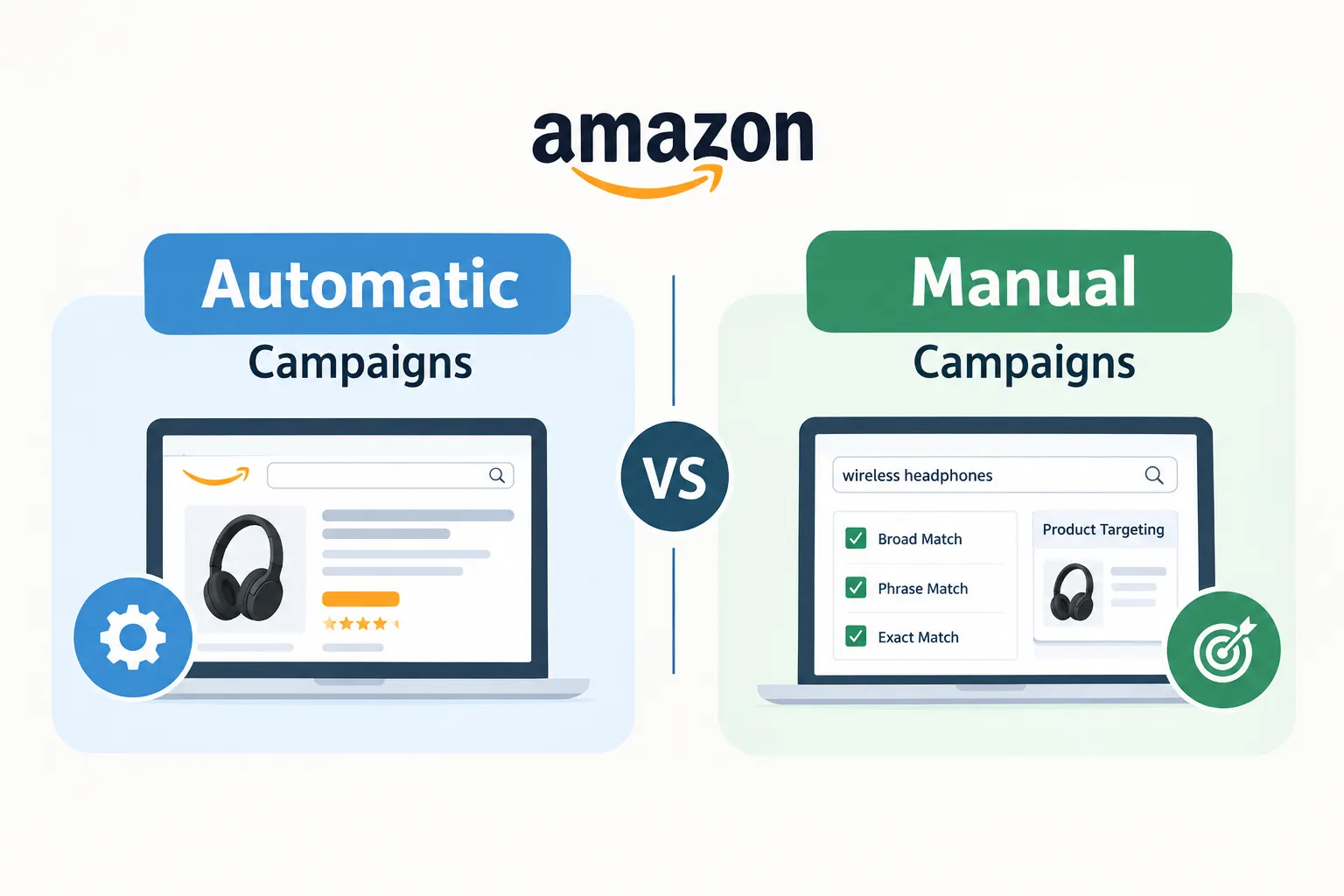
Amazon Automatic vs Manual Campaigns
Amazon advertising is one of the most effective ways for sellers to increase product visibility, attract potential customers, and grow sales. However, choosing the right advertising strategy can make a significant difference in campaign performance. One of the most common questions sellers ask is: Amazon Automatic vs Manual Campaigns which one is better for increasing sales and reducing advertising costs?
Both campaign types have different purposes. Automatic campaigns allow Amazon’s advertising system to identify relevant customer searches and target products based on its algorithm. Manual campaigns give sellers greater control over keywords, product targeting, and advertising bids. Understanding these differences can help you make smarter advertising decisions.
When comparing Amazon Automatic vs Manual Campaigns, it is important to consider your advertising budget, product category, competition, and business goals. A new seller may benefit from automatic targeting to discover relevant search terms, while an experienced seller may prefer manual targeting to focus on high-converting keywords.
In this guide, we will explain how both campaign types work, their advantages and disadvantages, their key differences, and how to choose the right Amazon PPC strategy. We will also discuss how professional Amazon PPC Management Services can help improve advertising performance and generate better returns.
Read more – What Documents Are Required
What Are Amazon Automatic Campaigns?
An Amazon Automatic Campaign is a Sponsored Products advertising campaign in which Amazon automatically selects relevant search terms and product placements for your advertisements.
Instead of manually selecting keywords, sellers allow Amazon’s advertising algorithm to identify potential customers based on product information, listing content, and shopping behaviour.
For example, if you sell wireless headphones, Amazon may automatically display your advertisement for relevant customer searches such as:
- Bluetooth headphones
- Wireless earbuds
- Noise-cancelling headphones
- Headphones for mobile phones
Amazon uses different targeting groups to identify relevant opportunities.
Types of Automatic Targeting
Amazon Automatic Campaigns generally include four targeting groups:
1. Close Match
Amazon displays your advertisement for search terms closely related to your product.
For example, if you sell a wireless keyboard, your advertisement may appear when customers search for wireless keyboards.
2. Loose Match
Your advertisement can appear for broader search terms that are related to your product but may not be an exact match.
This targeting helps sellers discover additional customer searches.
3. Substitutes
Amazon targets products similar to yours. Your advertisement may appear on the product detail pages of competing or alternative products.
4. Complements
Your advertisement may appear alongside products that customers commonly purchase or use with your product.
For example, if you sell a laptop, Amazon may show your advertisement on related accessory product pages.
Benefits of Amazon Automatic Campaigns
Automatic campaigns offer several advantages:
- Easy Campaign Setup: You do not need to research and add keywords manually.
- Keyword Discovery: Find new search terms that customers use to discover your products.
- Product Targeting: Reach shoppers browsing related and competing products.
- Time Saving: Amazon handles much of the targeting process.
- Useful for New Sellers: Beginners can start advertising without extensive keyword research.
Disadvantages of Automatic Campaigns
Despite their benefits, automatic campaigns also have some limitations:
- Less control over individual keyword targeting.
- Some clicks may come from irrelevant search terms.
- Advertising costs can increase without proper optimization.
- Difficult to focus exclusively on specific high-converting keywords.
- Requires regular search term analysis and negative targeting.
What Are Amazon Manual Campaigns?
An Amazon Manual Campaign is a Sponsored Products advertising campaign where sellers select their own keywords or products to target.
Unlike automatic campaigns, manual campaigns provide greater control over keyword selection, match types, product targeting, and individual bids.
For example, if you sell a stainless steel water bottle, you can manually target keywords such as:
- Stainless steel water bottle
- Insulated water bottle
- Water bottle for office
- Reusable water bottle
You can also choose specific competitor products or product categories to target.
Types of Manual Campaign Targeting
Amazon Manual Campaigns offer two main targeting options.
1. Keyword Targeting
With keyword targeting, sellers select search terms that are relevant to their products.
Amazon provides three keyword match types:
Broad Match: Your advertisement can appear for searches related to your keyword, including variations and related terms.
Phrase Match: Your advertisement can appear when a customer’s search includes your keyword phrase in the same order, with additional words before or after it.
Exact Match: Your advertisement can appear for searches that closely match your selected keyword, including close variations.
2. Product Targeting
Product targeting allows sellers to display advertisements on specific product detail pages or within selected product categories.
You can target:
- Competitor ASINs
- Similar products
- Specific product categories
- Relevant product brands
- Products within selected price ranges or other available refinements
Benefits of Amazon Manual Campaigns
Manual campaigns offer several important advantages:
- Greater Control: Select your own keywords and product targets.
- Better Keyword Focus: Target search terms relevant to your products.
- Bid Management: Adjust bids based on keyword performance.
- Competitor Targeting: Advertise on relevant competitor product pages.
- Performance Optimization: Separate high-performing and low-performing keywords into different campaigns.
Disadvantages of Manual Campaigns
Manual campaigns also require more attention and expertise.
- Keyword research takes time.
- Incorrect keyword selection can waste advertising budgets.
- Competitive keywords may have higher CPC.
- Regular bid adjustments are necessary.
- Campaign structure and optimization require experience.
Amazon Automatic vs Manual Campaigns: Key Differences
The main difference between Amazon Automatic vs Manual Campaigns is the level of control over advertising targeting.
Automatic campaigns allow Amazon to identify targeting opportunities, whereas manual campaigns let sellers select their own keywords and products.
Here is a comparison to help you understand both options.
| Comparison | Automatic Campaigns | Manual Campaigns |
|---|---|---|
| Targeting | Amazon selects targets | Seller selects targets |
| Keyword Research | Mostly automated | Manual keyword research |
| Control | Limited | Greater control |
| Setup | Easy | Requires research |
| Keyword Discovery | Very useful | Depends on selected keywords |
| Bid Management | Target-level bid control | Keyword or target-level bid control |
| Negative Targeting | Available | Available |
| Best For | Research and discovery | Focused targeting |
| Optimization | Search term analysis | Keyword and bid analysis |
Which Campaign Offers Better Control?
Manual campaigns offer greater control because sellers can select specific keywords, match types, product targets, and bids.
Automatic campaigns are more suitable when sellers want Amazon to discover relevant search terms and product placements.
Which Campaign Is Better for Beginners?
Automatic campaigns are often a good starting point for beginners because they require less keyword research and are relatively easy to set up.
However, beginners should still monitor search term reports and advertising costs regularly.
Amazon Automatic vs Manual Campaigns: Which Is Better for Sales?
There is no single winner when comparing Amazon Automatic vs Manual Campaigns. Both campaign types can generate sales when they are properly structured and optimized.
The better option depends on your business goals.
Choose Automatic Campaigns if:
- You are launching a new product.
- You have limited keyword research data.
- You want to discover customer search terms.
- You want to identify potential competitor products.
- You want to collect data before creating manual campaigns.
Choose Manual Campaigns if:
- You already know your profitable keywords.
- You want more control over advertising bids.
- You want to target specific competitor ASINs.
- You want to improve performance for high-converting search terms.
- You want to create a structured advertising strategy.
For many sellers, using both campaign types together is a more practical approach than relying on only one.
Can You Run Amazon Automatic and Manual Campaigns Together?
Yes. You can run Amazon Automatic and Manual Campaigns simultaneously for the same product.
In fact, combining both campaign types can help sellers discover new opportunities while maintaining control over their important keywords.
Here is a simple strategy:
Step 1: Start with an Automatic Campaign
Create an automatic campaign for your product.
Allow it to collect search term and product targeting data. Monitor the results regularly instead of judging performance based on only a few clicks.
Step 2: Analyse the Search Term Report
Review the customer search terms generating clicks, orders, and sales.
Identify keywords that show positive performance.
Focus on:
- Relevant customer search terms.
- Keywords generating orders.
- Search terms with reasonable ACoS.
- Product targets generating profitable sales.
Step 3: Move Successful Keywords into Manual Campaigns
Create a manual campaign using the keywords discovered through automatic targeting.
Organize your campaigns based on product relevance and advertising goals.
For example:
- Campaign 1: High-performing exact-match keywords.
- Campaign 2: Broad-match keyword discovery.
- Campaign 3: Phrase-match targeting.
- Campaign 4: Competitor ASIN targeting.
Step 4: Add Negative Keywords
Identify irrelevant or unprofitable search terms and consider adding them as negative keywords or negative product targets where appropriate.
This helps reduce unnecessary advertising spend.
Remember that negative targeting should be based on sufficient performance data and product relevance, not just a small number of clicks.
Step 5: Monitor and Optimize Performance
Review campaign performance regularly.
Track important advertising metrics such as:
- ACoS (Advertising Cost of Sales)
- ROAS (Return on Ad Spend)
- CPC (Cost Per Click)
- CTR (Click-Through Rate)
- Impressions
- Clicks
- Orders
- Conversion Rate
This process helps you understand which campaigns are contributing to your business goals.
Important Amazon PPC Metrics You Should Understand
To make the right decision between Amazon Automatic vs Manual Campaigns, you should understand the key performance metrics.
1. ACoS (Advertising Cost of Sales)
ACoS measures how much you spend on advertising compared with the sales generated through advertisements.
Formula:
ACoS = (Advertising Spend ÷ Advertising Sales) × 100
For example:
If you spend ₹2,000 on advertising and generate ₹10,000 in advertising sales, your ACoS is 20%.
A lower ACoS is not always better. Your target should depend on product margins, profit goals, and advertising objectives.
2. ROAS (Return on Ad Spend)
ROAS measures the advertising revenue generated for every rupee spent.
Formula:
ROAS = Advertising Sales ÷ Advertising Spend
For example:
If your advertising spend is ₹2,000 and advertising sales are ₹10,000, your ROAS is 5.
This means you generate ₹5 in advertising sales for every ₹1 spent.
3. CPC (Cost Per Click)
CPC represents the average amount you pay for each advertising click.
A higher CPC can affect profitability, particularly when your product has a low selling price or limited profit margin.
4. CTR (Click-Through Rate)
CTR measures how many shoppers click on your advertisement compared with the number of impressions.
A good CTR can indicate that your advertisement is relevant and attractive to potential customers.
5. Conversion Rate
Conversion rate measures the percentage of clicks that result in orders.
If your advertisement receives traffic but generates very few sales, you should review your product listing, price, images, reviews, and overall customer experience.
Common Mistakes Sellers Make in Amazon PPC Campaigns
Even a well-planned advertising campaign can waste money if it is not managed correctly.
Here are some common mistakes sellers should avoid.
1. Using Too Many Irrelevant Keywords
Adding unrelated keywords can attract clicks from shoppers who are not interested in your product.
Always prioritize keyword relevance.
2. Ignoring Search Term Reports
Search term reports help sellers understand what customers actually search for before clicking their advertisements.
Ignoring these reports can result in missed opportunities and unnecessary advertising expenses.
3. Not Adding Negative Keywords
Negative keywords help prevent advertisements from appearing for unwanted searches.
Without proper negative targeting, campaigns may continue spending money on irrelevant traffic.
4. Setting Bids Without Research
High bids do not guarantee better sales. Similarly, very low bids may limit advertising visibility.
Set bids according to competition, conversion performance, and profitability.
5. Ignoring Product Listing Optimization
Amazon PPC cannot solve every listing problem.
If your product title, images, description, pricing, or reviews are not competitive, advertising traffic may not convert into orders.
6. Stopping Campaigns Too Early
New campaigns need sufficient time and data for meaningful evaluation.
Avoid making major changes based on only a few clicks or short-term fluctuations.
How Avisha Digital Services Can Help Improve Your Amazon PPC Performance
Managing Amazon advertisements requires more than creating campaigns and increasing bids. Sellers need a proper advertising strategy, keyword research, regular optimization, and performance analysis.
Avisha Digital Services provides professional Amazon PPC Management Services to help sellers improve advertising performance and build a more structured marketplace growth strategy.
Our team focuses on understanding your products, competition, advertising goals, and profit margins before recommending a campaign structure.
Our Amazon PPC Management Services Include:
- Amazon Automatic Campaign Setup
- Amazon Manual Campaign Management
- Keyword Research and Optimization
- Sponsored Products Advertising
- Sponsored Brands and Sponsored Display Campaign Support
- Search Term Report Analysis
- Negative Keyword Management
- Competitor ASIN Targeting
- Bid and Budget Optimization
- ACoS and ROAS Monitoring
- Advertising Performance Reporting
Whether you are a new Amazon seller or an established brand, our goal is to help you make better advertising decisions through data-driven campaign management.
With Avisha Digital Services, you can focus on managing your business while our team works on improving your Amazon advertising strategy.
Best Practices for Managing Amazon Automatic vs Manual Campaigns
To get better results from your advertising campaigns, follow these practical recommendations:
- Start with relevant automatic targeting to discover new search terms.
- Review search term reports to identify keywords generating sales.
- Create separate manual campaigns for important keywords.
- Use broad, phrase, and exact match types according to your objectives.
- Test competitor ASIN targeting where relevant.
- Add negative keywords to reduce irrelevant traffic.
- Monitor ACoS, ROAS, CPC, CTR, and conversion rates.
- Optimize product listings before increasing advertising budgets.
- Adjust bids based on campaign performance and profit margins.
- Review campaign performance regularly and make data-driven decisions.
The most important point is to treat Amazon advertising as an ongoing optimization process rather than a one-time setup.
Conclusion: Amazon Automatic vs Manual Campaigns Which Should You Choose?
When comparing Amazon Automatic vs Manual Campaigns, both have their own advantages. Automatic campaigns are useful for discovering relevant search terms, identifying product targeting opportunities, and collecting advertising data. Manual campaigns provide greater control over keywords, bids, and product targeting.
For most sellers, combining both campaign types can create a balanced advertising strategy. You can use automatic campaigns for research and manual campaigns to focus on relevant, high-performing keywords.
However, successful Amazon advertising depends on regular optimization, proper keyword selection, listing quality, and budget management.
If you want to improve your Amazon advertising performance, Avisha Digital Services can help you build and manage an effective PPC strategy.
Ready to improve your Amazon advertising performance?
Contact Avisha Digital Services for professional Amazon PPC Management Services and get expert support for your Amazon seller account.
Website: https://avishadigitalservices.com/
Call to Action: Get a Free Amazon PPC Consultation.
Frequently Asked Questions (FAQs)
1. What is the difference between Amazon Automatic vs Manual Campaigns?
The main difference between Amazon Automatic vs Manual Campaigns is targeting control. Automatic campaigns allow Amazon to select relevant targets, while manual campaigns let sellers choose specific keywords, match types, and product targets.
2. Which is better, Amazon Automatic or Manual Campaigns?
Both can be effective depending on your goals. Automatic campaigns are useful for keyword discovery and product research, whereas manual campaigns are better for focused keyword targeting and bid control. Using both together can be an effective strategy.
3. Can I run Amazon Automatic and Manual Campaigns together?
Yes. You can run both campaign types simultaneously. Automatic campaigns can help identify relevant search terms, which you can later use in manual campaigns to target valuable keywords more precisely.
4. How much budget should I spend on Amazon Automatic vs Manual Campaigns?
There is no fixed advertising budget for every seller. Your budget should depend on product price, competition, profit margins, keyword costs, and business objectives. Start with a manageable budget and adjust it according to campaign performance.
5. How can I reduce ACoS in Amazon Automatic vs Manual Campaigns?
You can work towards reducing ACoS by optimizing keywords, adjusting bids, adding negative keywords, improving product listings, and monitoring search term reports. Focus on profitable sales rather than simply reducing advertising costs.



Leave a Reply